
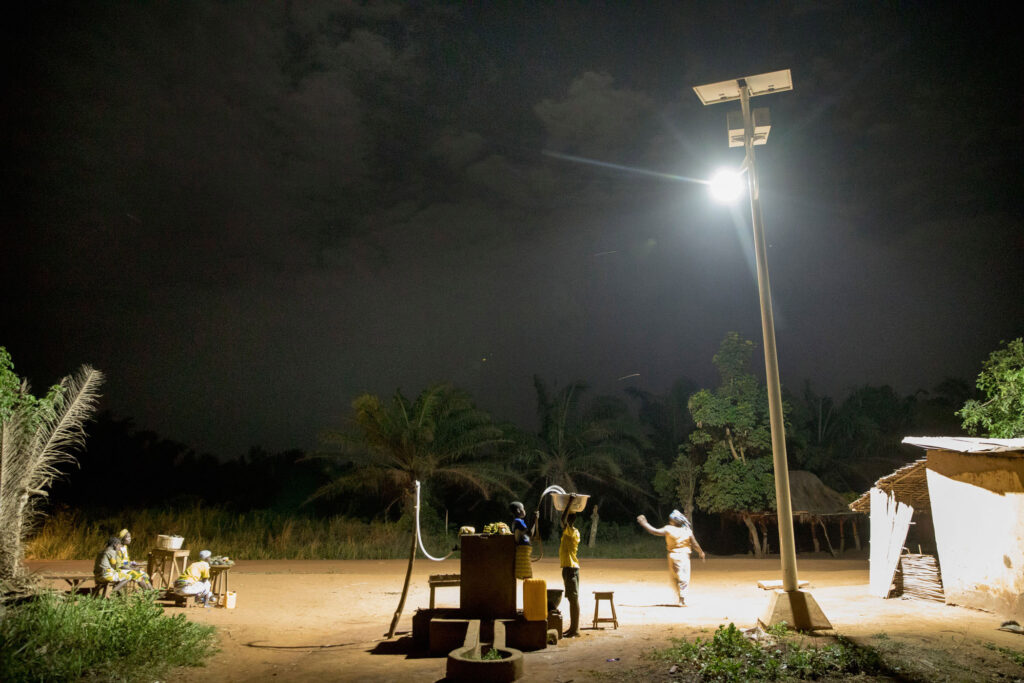
Solar street lighting is one of Cameroon’s most promising clean-energy solutions. As many urban and rural areas continue to face unreliable or inaccessible grid electricity, municipalities are increasingly turning to solar street lights to improve safety, reduce energy costs, and support local economic activity at night.
1. Major Solar Street Lighting Projects Transforming Cities and Rural Areas
A national-scale project: 100,750 solar street lights
In 2022, Cameroon’s Association of United Councils and Cities (CVUC) signed a landmark agreement with French manufacturer Sunna Design to roll out 100,750 autonomous solar street lamps across rural municipalities in Cameroon. The plan includes a local assembly facility in Yaoundé 7, supporting long-term maintenance and job creation. https://tinyurl.com/4ma6uyy2
Smart solar lighting in Yaoundé
In 2025, Omexom Cameroon launched a smart solar lighting project in collaboration with the Urban Community of Yaoundé (CUY) including the installation of 100 remotely monitored solar street lights.
This project resulted in about 90% reduction in energy consumption and maintenance costs. https://tinyurl.com/ymyv7ur4
188 solar streetlights were installed in Dschang and Foumbot while over 240 solar streetlights installed in regional capitals.
Garoua’s climate-action lighting initiative
Under the umbrella of CoM SSA (Covenant of Mayors – Sub-Saharan Africa), the city of Garoua installed 100 new solar street lights and renovated 212 existing ones. The project achieved:
78% reduction in energy consumption,
≈ 587 tonnes CO₂ avoided annually. https://tinyurl.com/5v69856m
2. Why Solar Street Lighting Matters in Cameroon
Improve energy access
Cameroon’s decentralized solar market is growing fast. As part of the broader shift toward off-grid and hybrid solar capacity, solar street lights provide a reliable lighting solution even where grid access is limited or unstable. According to industry reporting, this shift has helped expand electrification across rural and peri-urban areas. https://tinyurl.com/ymyv7ur4
Lower energy bills and cleaner cities
LED solar street lights drastically reduce municipal energy demand and maintenance costs. In Yaoundé, the smart solar project cut energy consumption by ~ 90%. Using solar lighting helps reduce reliance on diesel generators and decreases carbon emissions, contributing to cleaner, greener cities. https://tinyurl.com/28fv65y9
Social and economic impact
Improved lighting leads to better night-time safety, supports market activity, facilitates mobility after dark, and enables community life in evenings. The Garoua case shows clear benefits in public lighting, safety, and social activity. https://tinyurl.com/5v69856m
3. Challenges to Scaling Solar Street Lighting
Despite progress, scaling remains difficult because:
- Maintenance capacity is limited — batteries, solar panels, and control units require regular upkeep, which can be challenging with constrained municipal budgets.
Upfront costs of “smart” systems (storage, EMS, remote monitoring) remain a barrier without external funding or public-private partnerships.
Many municipalities still rely on traditional grid or diesel systems — adoption of solar is gradual and depends on policy, funding, and long-term commitment.
These challenges are implicit in project reports and the uneven distribution of installations.
4. How to Scale Solar Street lights Effectively
To accelerate and scale solar street lighting across Cameroon, stakeholders should focus on:
Hybrid solar + storage + smart management — as shown in Yaoundé, these systems offer reliable, efficient, and cost-effective lighting.
Target underserved rural and peri-urban areas — where grid access is minimal and impact from lighting is highest.
Public-Private Partnerships (PPP) — to mobilize financing and enable technology transfer.
Local manufacturing and maintenance capacity — building up a local supply and servicing base (as planned with the Sunna Design facility) ensures sustainability.
Data-driven planning and monitoring — track energy/maintenance savings, lighting coverage, and social impact to justify further investments and attract donors or investors.
Conclusion
Solar street lighting is already reshaping public life in Cameroon — improving safety, reducing costs, enabling nighttime commerce, and supporting sustainable development. National-scale programmes, city pilots, and climate-action initiatives are lighting up streets, towns, and communities across the country.
With strategic planning, stronger public-private collaborations, and sustained investment in decentralized solar infrastructure, solar street lighting can become a central pillar of Cameroon’s urban and rural energy strategy — delivering both social and climate benefits.